Entry Filters: Break-Quality & Session Timing
1. Break-Quality Features
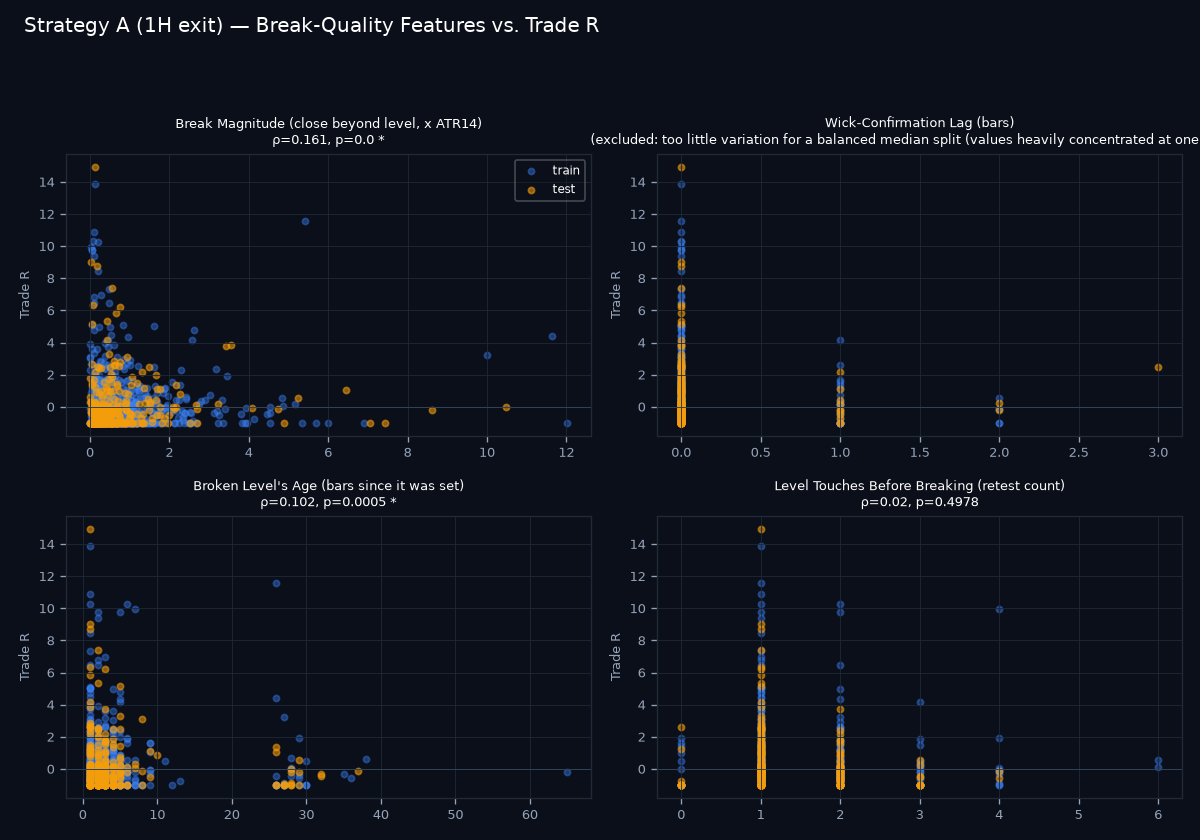
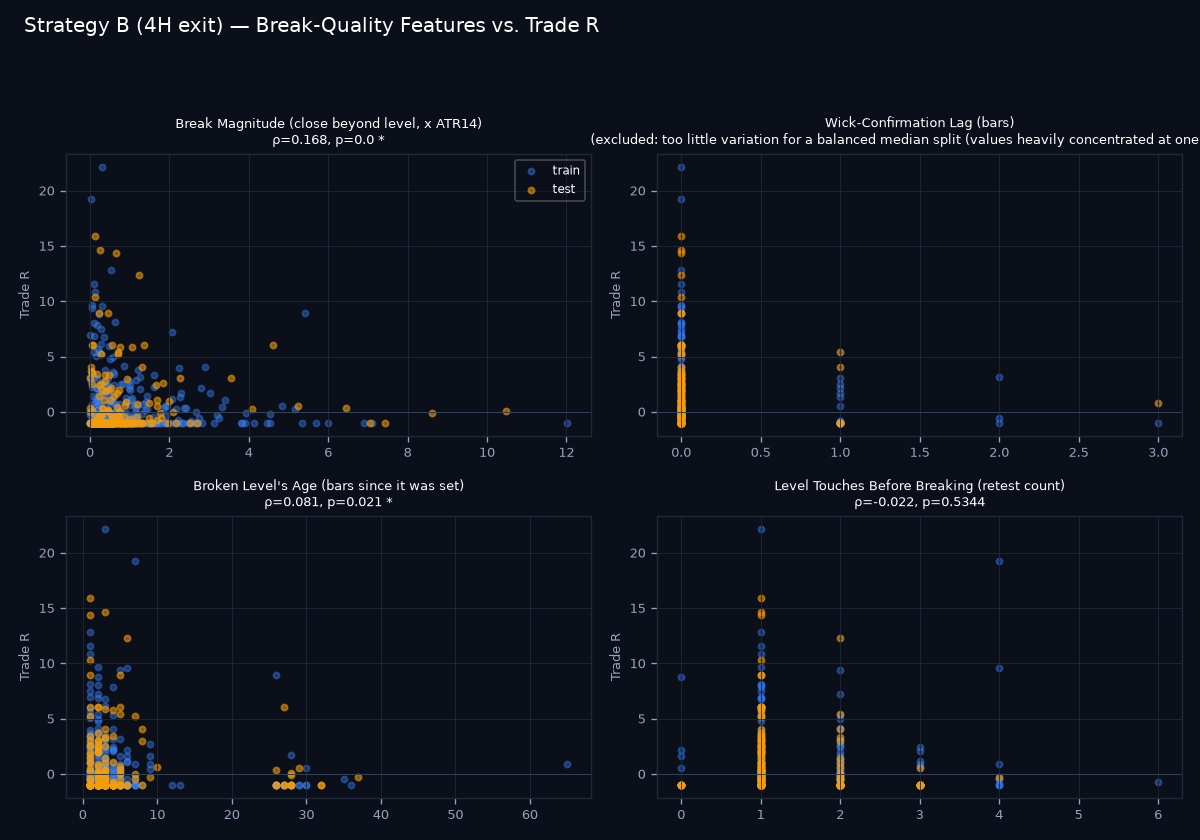
Properties of the specific break that triggered each entry — how far it cleared the level, how long the level had stood, how many times it was retested first — rather than the ambient market environment. All are intrinsic to the BOS/CHoCH signal itself.
Strategy A
| Metric | Spearman ρ | p-value | Significant? | Train: filter vs. other | Test: filter vs. other | Held up? |
|---|---|---|---|---|---|---|
| Break Magnitude (close beyond level, x ATR14) | +0.161 | 0.0000 | p < 0.05 | -0.04R vs -0.04R | -0.21R vs +0.08R | did not hold up |
| Wick-Confirmation Lag (bars) | excluded — too little variation for a balanced median split (values heavily concentrated at one value) | |||||
| Broken Level's Age (bars since it was set) | +0.102 | 0.0005 | p < 0.05 | +0.03R vs -0.08R | +0.09R vs -0.16R | held up |
| Level Touches Before Breaking (retest count) | +0.020 | 0.4978 | n.s. | -0.03R vs -0.38R | -0.07R vs -0.24R | held up |
Strategy B
| Metric | Spearman ρ | p-value | Significant? | Train: filter vs. other | Test: filter vs. other | Held up? |
|---|---|---|---|---|---|---|
| Break Magnitude (close beyond level, x ATR14) | +0.168 | 0.0000 | p < 0.05 | +0.03R vs -0.18R | +0.05R vs +0.43R | did not hold up |
| Wick-Confirmation Lag (bars) | excluded — too little variation for a balanced median split (values heavily concentrated at one value) | |||||
| Broken Level's Age (bars since it was set) | +0.081 | 0.0210 | p < 0.05 | -0.06R vs -0.10R | +0.12R vs +0.52R | did not hold up |
| Level Touches Before Breaking (retest count) | -0.022 | 0.5344 | n.s. | +0.07R vs -0.08R | -1.00R vs +0.26R | did not hold up |
2. Session / Time-of-Day
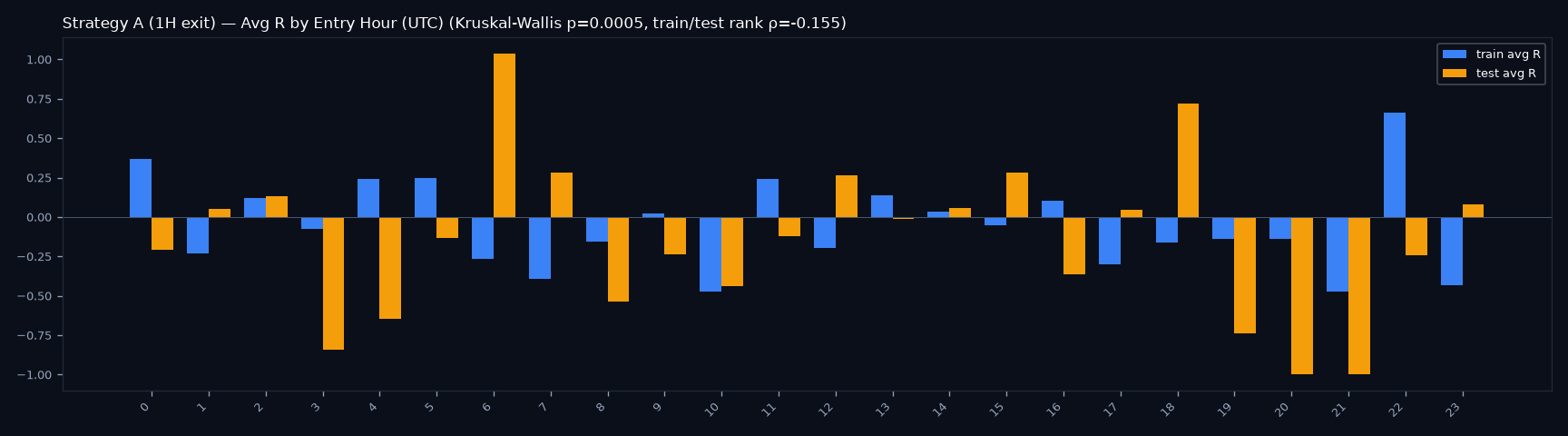
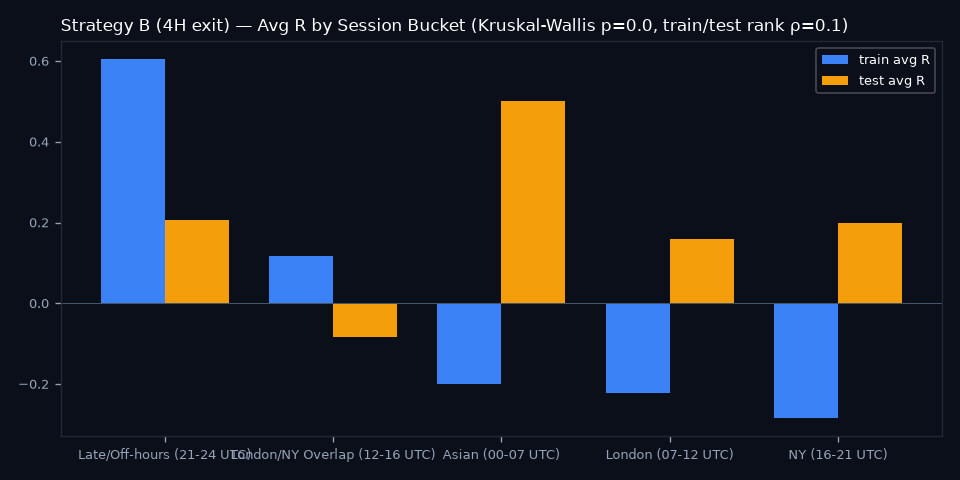
Entry hour (UTC), day-of-week, and a coarse session bucket (Asian/London/Overlap/NY/Off-hours). Purely calendar facts, so there is no lookahead risk at all — the question is only whether any grouping is stable, not whether it's knowable in advance. Kruskal-Wallis tests whether groups differ significantly within the training data; the train/test rank correlation checks whether the same groups stay best/worst in the untouched test data — the real test of whether a grouping means anything.
Strategy A
By Entry Hour (UTC): Kruskal-Wallis p=0.0005 (within-train group variation), train/test rank consistency ρ=-0.155 (p=0.4688)
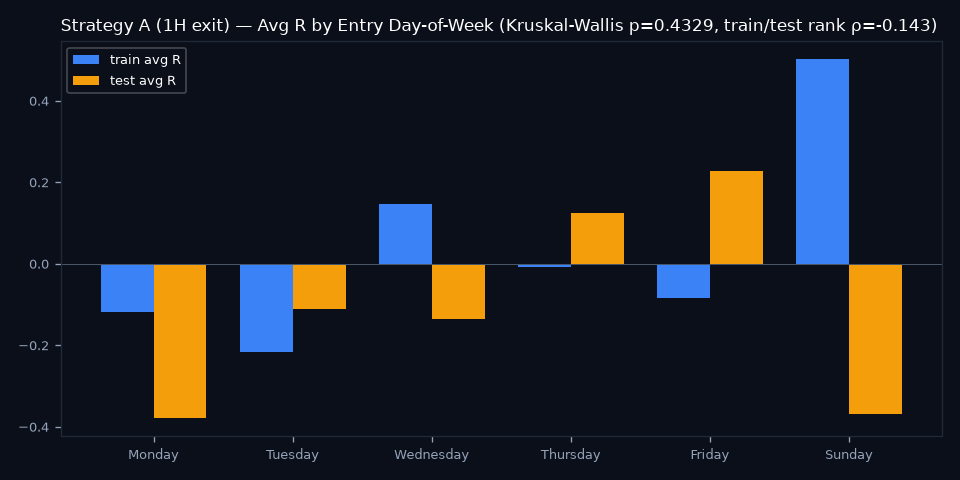
By Day of Week: Kruskal-Wallis p=0.4329 (within-train group variation), train/test rank consistency ρ=-0.143 (p=0.7872)
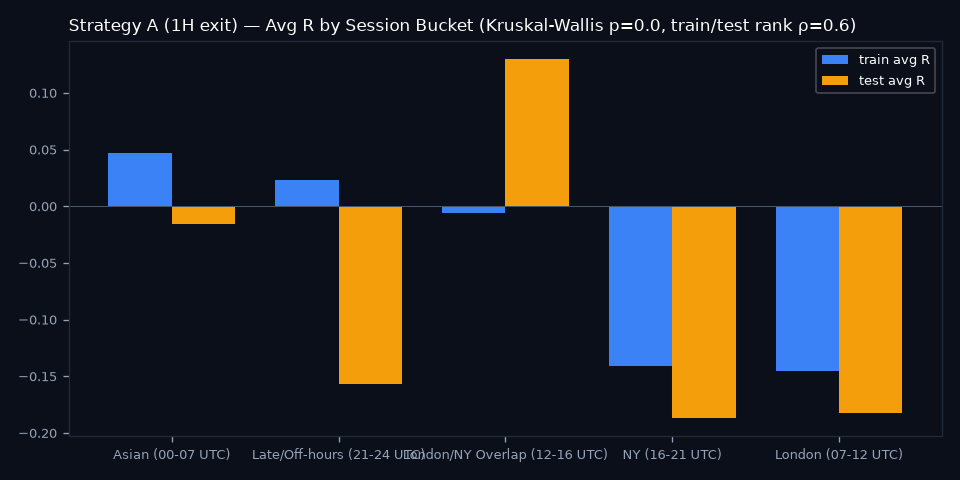
By Session Bucket: Kruskal-Wallis p=0.0 (within-train group variation), train/test rank consistency ρ=0.6 (p=0.2848)
Strategy B
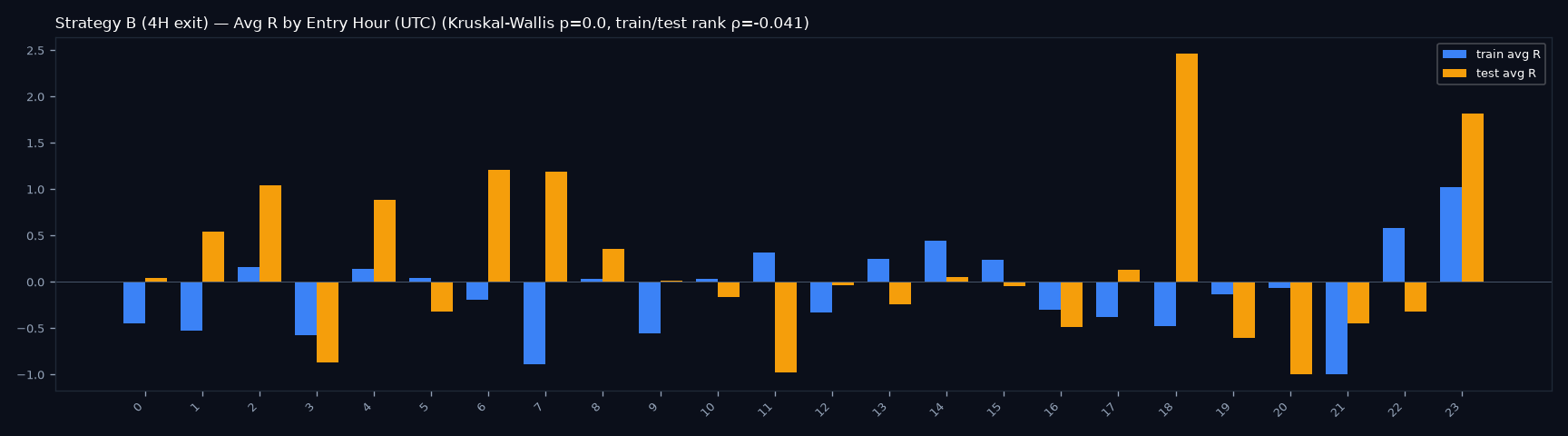
By Entry Hour (UTC): Kruskal-Wallis p=0.0 (within-train group variation), train/test rank consistency ρ=-0.041 (p=0.8496)
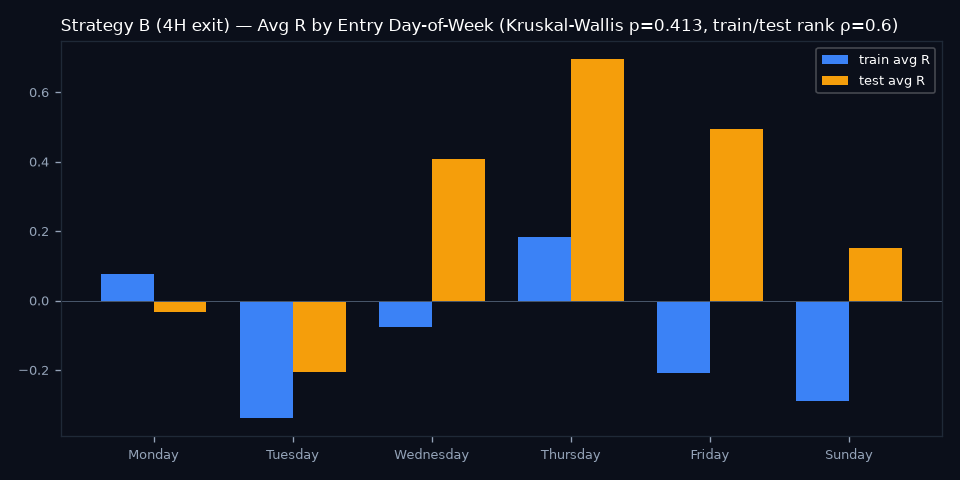
By Day of Week: Kruskal-Wallis p=0.413 (within-train group variation), train/test rank consistency ρ=0.6 (p=0.208)
By Session Bucket: Kruskal-Wallis p=0.0 (within-train group variation), train/test rank consistency ρ=0.1 (p=0.8729)
3. Unused Multi-Timeframe Information
The Pine script already computes Daily bias and displays it on the dashboard, but neither strategy's entry logic uses it. Two questions: does requiring Daily bias to also agree with the trade direction (not just 4H) help, and does how long the 4H bias has already been running at entry ('trend maturity') matter — trading a fresh 4H turn vs. chasing an extended one?
Strategy A
Daily-Bias Alignment
| Group | Train avg R (n) | Test avg R (n) |
|---|---|---|
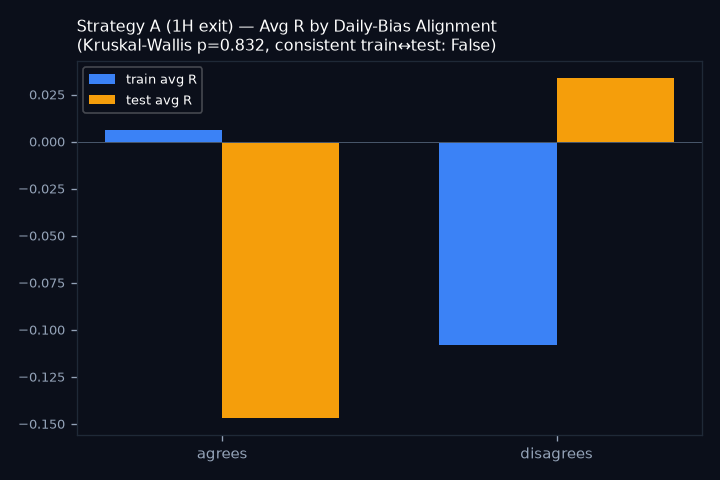
| agrees | +0.01R (n=464) | -0.15R (n=217) |
| disagrees | -0.11R (n=356) | +0.03R (n=137) |
Kruskal-Wallis p=0.832, consistent train→test: False
4H Trend Maturity (bars since 4H bias last flipped)
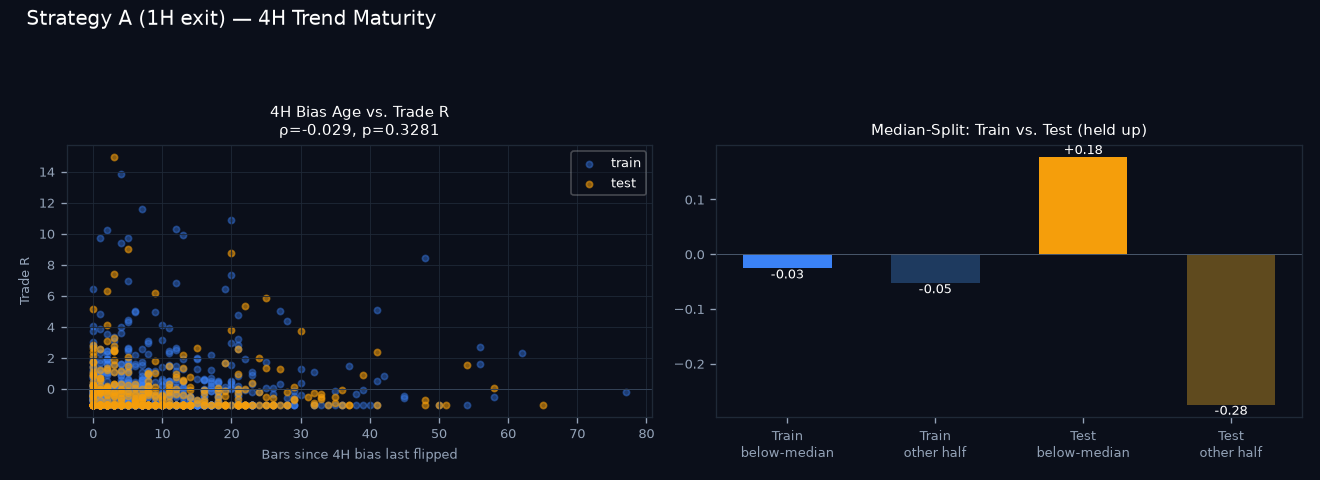
ρ=-0.029, p=0.3281 (not significant) — train below-median -0.03R vs -0.05R, test +0.18R vs -0.28R — held up
Strategy B
Daily-Bias Alignment
| Group | Train avg R (n) | Test avg R (n) |
|---|---|---|
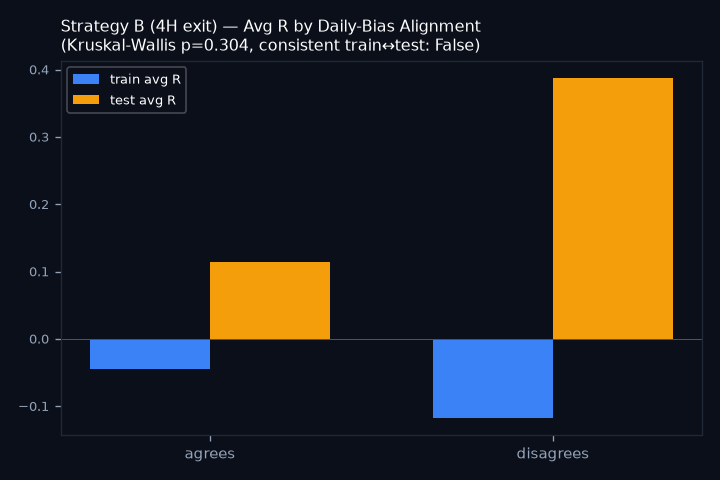
| agrees | -0.04R (n=304) | +0.11R (n=141) |
| disagrees | -0.12R (n=261) | +0.39R (n=103) |
Kruskal-Wallis p=0.304, consistent train→test: False
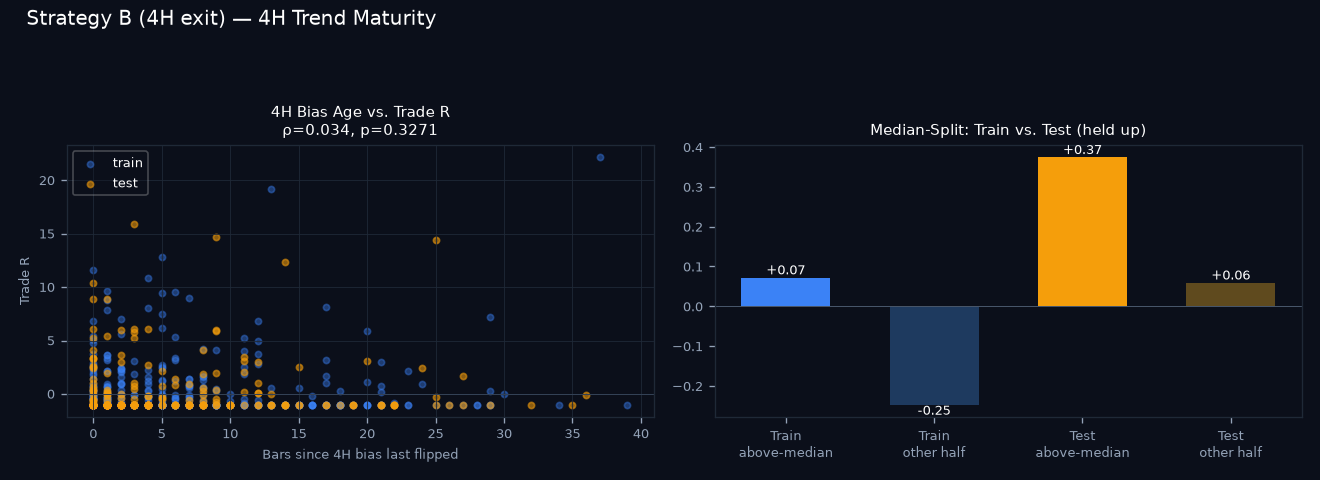
4H Trend Maturity (bars since 4H bias last flipped)
ρ=+0.034, p=0.3271 (not significant) — train above-median +0.07R vs -0.25R, test +0.37R vs +0.06R — held up