← All Markets
Overview
Strategy A
Strategy B
Trade Viewer
Regime Analysis
Entry Filters
Trading Costs
Monte Carlo
Variant Model →
Trading Costs: Gross vs. Net
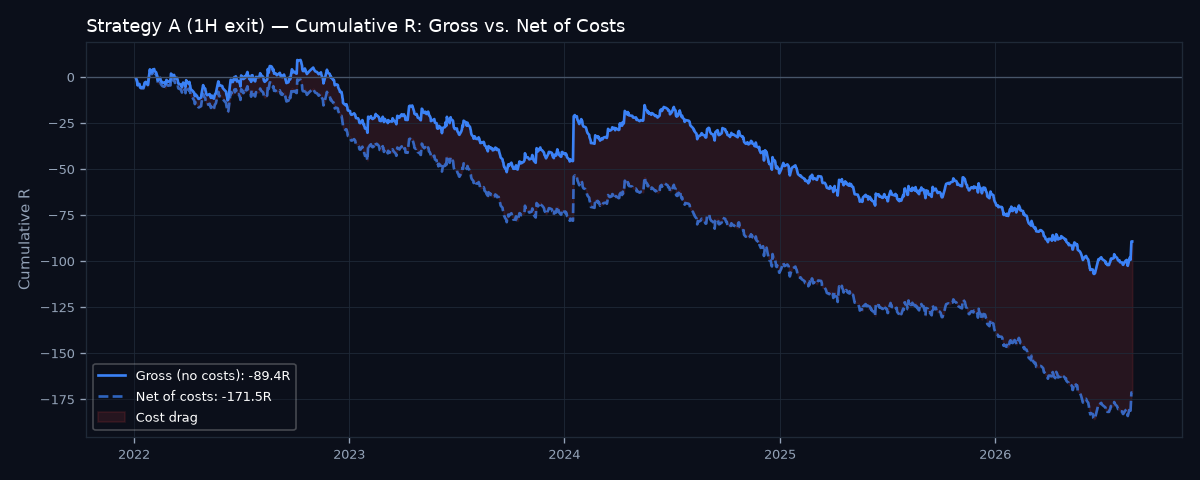
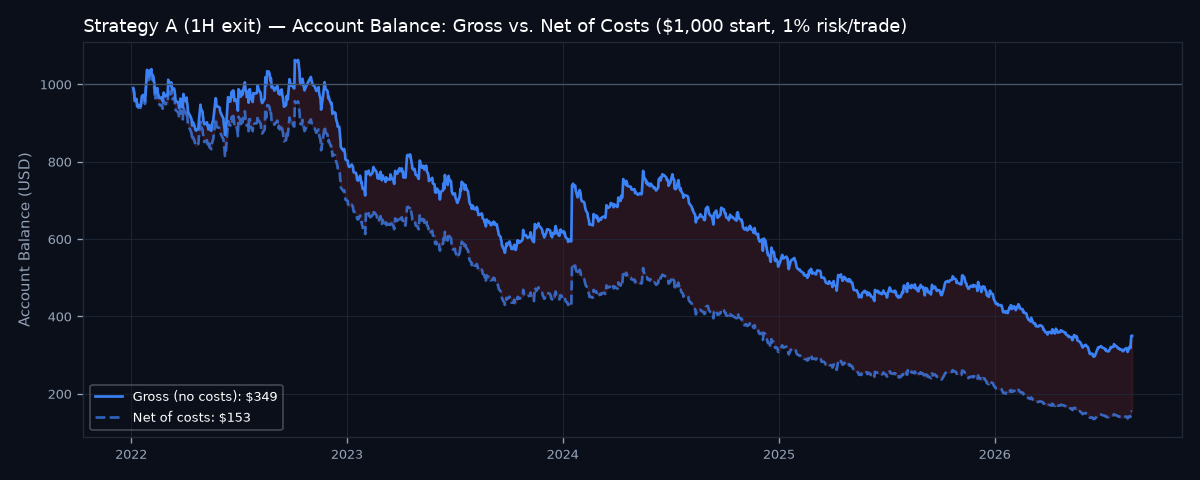
Every result shown elsewhere on this site is GROSS — zero spread, zero commission, zero slippage. This page applies a realistic broker cost model to every trade. Assumptions, from Euro / US Dollar (EUR/USD)'s cost basis (Vantage FX Raw ECN — user's own account Commission page ($5 USD/lot round-turn) + published spread range): spread $1e-05/unit, commission $5e-05/unit round-turn, and an estimated $4e-05/unit slippage — BOS/CHoCH entries and stop-outs both fire exactly when price is moving fast through a level, which is when slippage is worst; this is a working estimate, not a broker-quoted figure, and could be worse in a fast market. Total assumed round-trip cost: $0.0001/unit, converted to an R-multiple deduction using each trade's own risk (|entry − stop|) — the same normalization R itself already uses, so it applies consistently regardless of position size.
Strategy A
Avg cost per trade: 0.065R. edge does NOT survive costs
Avg R/Trade
-0.07 → -0.14
Total R
-89.4 → -171.5
Profit Factor
0.869 → 0.77
Win Rate
29.77% → 28.35%
Final Balance ($1,000 start)
$349 → $153
Strategy B
Avg cost per trade: 0.065R. edge does NOT survive costs
Avg R/Trade
-0.13 → -0.19
Total R
-108.6 → -164.2
Profit Factor
0.821 → 0.749
Win Rate
23.92% → 23.69%
Final Balance ($1,000 start)
$286 → $164
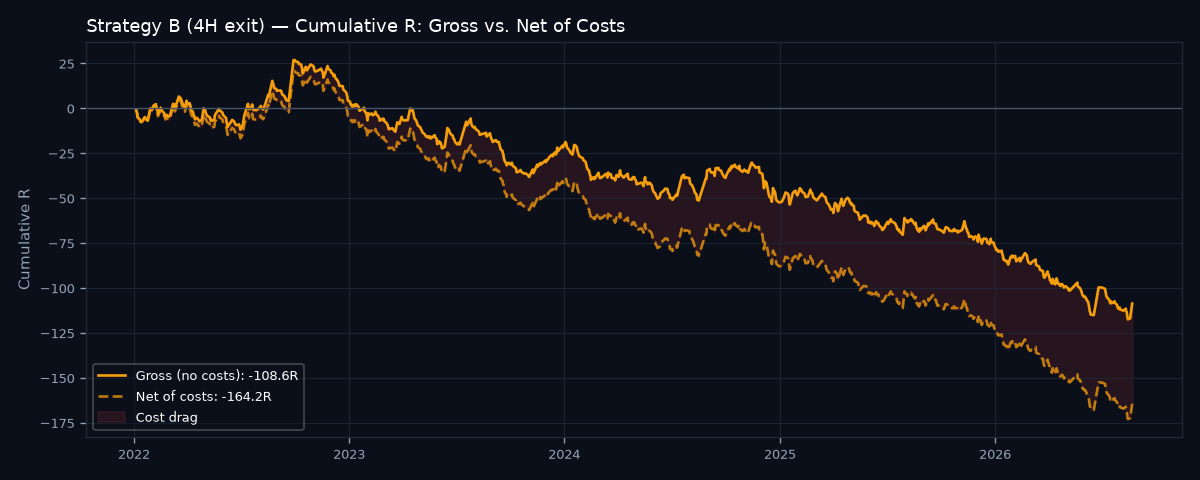
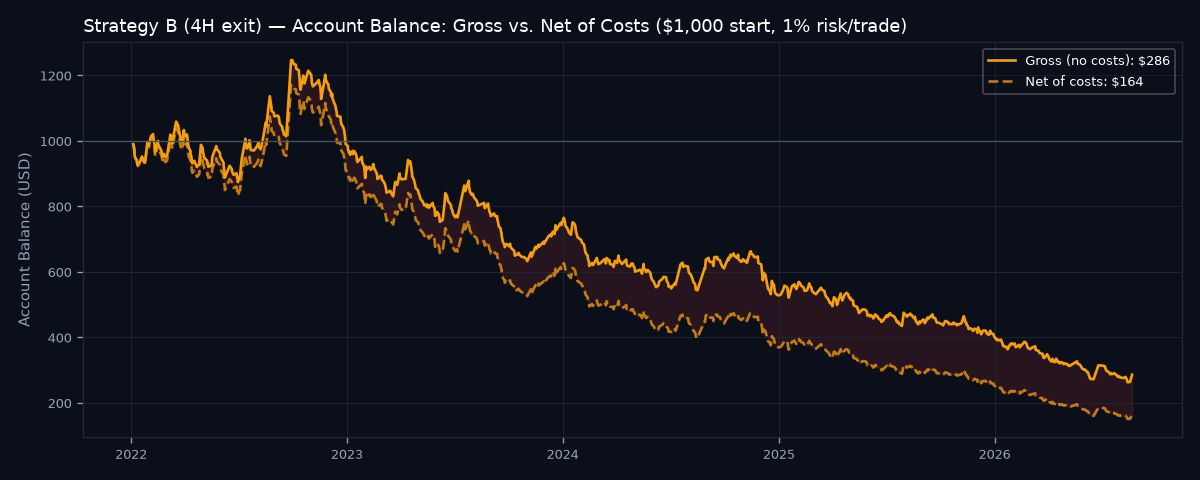
Read: at least one strategy does NOT survive this cost estimate — its apparent edge is an artifact of ignoring execution costs. Strategy A's total return is reduced by -91.9% after costs, Strategy B's by -51.2%. Whichever strategy has the thinner gross avg R/trade (here, Strategy A) has the least margin to absorb execution costs before its edge becomes marginal — if real slippage runs meaningfully higher than assumed here, that strategy is the one to re-examine first.